Chozha Army
Ponniyin SelvanThe Chozha Army is more than a measure of royal strength in the succession crisis: it is also a political force whose discontent could decide who rules. The narrative sets the ideal of courageous, loyal soldiers against an adviser’s warning that unrest within the ranks may be more dangerous than popular protest, then shows Aditha Karikalan turning the army’s imagined scale into a bargaining instrument.
Military Power and Royal Authority
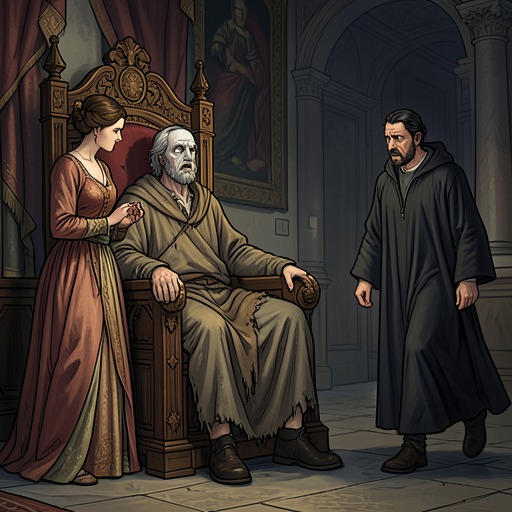
The court’s confidence in the army is expressed through the king’s challenge to his chief minister: if the people rebel, surely the celebrated soldiers will remain a byword for courage and loyalty? The reply overturns that assumption. The minister says the greatest turmoil is among the troops, distinguishing trained soldiers from subjects whose opposition might amount to loud complaints and disorderly protests. In his forecast, soldiers could reduce the Thanjavur fort to a smouldering ruin, imprison the Pazhuvettarayar lords and Madhuranthaka Thevar, and refuse to rest until Arulmozhi Varman was placed on the throne.
This warning makes the army’s allegiance a practical contest over sovereignty. A royal decision to recognize one claimant cannot by itself secure obedience: the soldiers may instead use their organized force to impose another outcome. The king answers by restating his resolve to make Madhuranthaka Thevar his successor, but the minister’s account exposes the danger of treating royal intention as equivalent to effective control.
The Army in the Succession Negotiations
At Kadambur, Aditha Karikalan raises the succession dispute before Periya Pazhuvettarayar and the assembled lords. He recalls that his father publicly crowned him heir, then says the king now appears to favor Madhuranthaka Thevar. Rather than simply declare which claim should prevail, Karikalan asks the lords to advise him and draws them into discussing a possible division of the kingdom. Periya Pazhuvettarayar presents partition as a compromise; Karikalan rejects breaking up the realm and offers, instead, to relinquish his claim in favor of Madhuranthaka Thevar if his military conditions are met.
Those conditions turn the army into the foundation of a proposed northern expedition. Karikalan demands three lakh soldiers, provisions and equipment for a year, and three hundred ships. He proposes that Parthibendra Pallava command the navy while he leads the land campaign northward. His plan is conditional and prospective, not an account of troops actually assembled or an invasion already under way. The scale of the demand nevertheless reveals how military resources are made to bear on the succession bargain: Karikalan presents relinquishment of the throne as compatible with a separate sphere of conquest and glory.
Numbers as Leverage
When Periya Pazhuvettarayar hesitates over the proposal and points to the need for Madhuranthaka Thevar’s permission and the king’s blessing, Karikalan presses the argument further. He claims that the treasury’s guardian could satisfy his requirements and that thirty lakh Chozha soldiers would volunteer for a northern invasion; he dismisses the three hundred ships as no serious obstacle. The vast figure is Karikalan’s assertion in a tense negotiation, not an independently confirmed count of the army.
The contrast between the three-lakh demand and the later claim of thirty lakh volunteers gives his proposal its theatrical force. He speaks as though the troops, ships and supplies could be summoned at will, while the minister’s earlier warning has already shown that the army’s actual political disposition is unsettled. The army therefore functions both as a material requirement for conquest and as a claim to popular and military support that Karikalan can deploy against the lords’ attempt to manage the succession.
Political Significance
Across these scenes, the Chozha Army is not depicted as a single collective action with a settled outcome. Instead, its possible choices sharpen the conflict among the king’s declared preference for Madhuranthaka Thevar, the soldiers’ reported desire for Arulmozhi Varman, and Karikalan’s willingness to exchange his succession claim for a campaign in the north. The army’s importance lies in this unresolved capacity: it can threaten the existing government, lend force to a rival claimant, or become the instrument of a prince’s military ambition.
The result is a portrait of kingship dependent on more than inheritance or proclamation. The court’s plans remain vulnerable so long as the soldiers’ loyalty cannot be assumed, and Karikalan’s grand military terms expose how quickly the language of service to the realm can become entangled with dynastic bargaining.